Amphibians are ectothermic, tetrapod vertebrates of the class Amphibia. All living amphibians belong to the group Lissamphibia. They inhabit a wide variety of habitats, with most species living within terrestrial, fossorial, arboreal or freshwater aquatic ecosystems. Thus amphibians typically start out as larvae living in water, but some species have developed behavioural adaptations to bypass this.
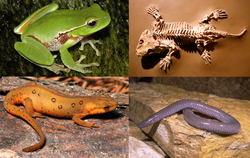

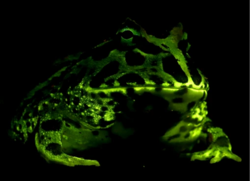
The young generally undergo metamorphosis from larva with gills to an adult air-breathing form with lungs. Amphibians use their skin as a secondary respiratory surface and some small terrestrial salamanders and frogs lack lungs and rely entirely on their skin. They are superficially similar to reptiles like lizards but, along with mammals and birds, reptiles are amniotes and do not require water bodies in which to breed. With their complex reproductive needs and permeable skins, amphibians are often ecological indicators; in recent decades there has been a dramatic decline in amphibian populations for many species around the globe.
The earliest amphibians evolved in the Devonian period from sarcopterygian fish with lungs and bony-limbed fins, features that were helpful in adapting to dry land. They diversified and became dominant during the Carboniferous and Permian periods, but were later displaced by reptiles and other vertebrates. The origin of modern amphibians belonging to Lissamphibia, which first appeared during the Early Triassic, around 250 million years ago, has long been contentious. However the emerging consensus is that they likely originated from temnospondyls, the most diverse group of prehistoric amphibians, during the Permian period.[4]
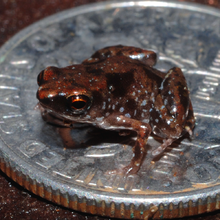
The three modern orders of amphibians are Anura (the frogs), Urodela (the salamanders), and Apoda (the caecilians), a fourth group, the Albanerpetontidae, became extinct around 2 million years ago. The number of known amphibian species is approximately 8,000, of which nearly 90% are frogs. The smallest amphibian (and vertebrate) in the world is a frog from New Guinea (Paedophryne amauensis) with a length of just 7.7 mm (0.30 in). The largest living amphibian is the 1.8 m (5 ft 11 in) South China giant salamander (Andrias sligoi), but this is dwarfed by the extinct 9 m (30 ft) Prionosuchus from the middle Permian of Brazil. The study of amphibians is called batrachology, while the study of both reptiles and amphibians is called herpetology.
Classification
The word amphibian is derived from the Ancient Greek term ἀμφίβιος (amphíbios), which means 'both kinds of life', ἀμφί meaning 'of both kinds' and βιος meaning 'life'. The term was initially used as a general adjective for animals that could live on land or in water, including seals and otters.[5] Traditionally, the class Amphibia includes all tetrapod vertebrates that are not amniotes. Amphibia in its widest sense (sensu lato) was divided into three subclasses, two of which are extinct:[6]
- Subclass Lepospondyli† (small Paleozoic group, which are more closely related to amniotes than Lissamphibia)
- Subclass Temnospondyli† (diverse Paleozoic and early Mesozoic grade)
- Subclass Lissamphibia (all modern amphibians, including frogs, toads, salamanders, newts and caecilians)
- Salientia (frogs, toads and relatives): Jurassic to present—7,360 current species in 53 families[7]
- Caudata (salamanders, newts and relatives): Jurassic to present—764 current species in 9 families[7]
- Gymnophiona (caecilians and relatives): Jurassic to present—215 current species in 10 families[7]
- Allocaudata† (Albanerpetontidae) Middle Jurassic – Early Pleistocene
The actual number of species in each group depends on the taxonomic classification followed. The two most common systems are the classification adopted by the website AmphibiaWeb, University of California, Berkeley, and the classification by herpetologist Darrel Frost and the American Museum of Natural History, available as the online reference database "Amphibian Species of the World".[8] The numbers of species cited above follows Frost and the total number of known amphibian species as of March 31, 2019, is exactly 8,000,[9] of which nearly 90% are frogs.[10]
With the phylogenetic classification, the taxon Labyrinthodontia has been discarded as it is a polyparaphyletic group without unique defining features apart from shared primitive characteristics. Classification varies according to the preferred phylogeny of the author and whether they use a stem-based or a node-based classification. Traditionally, amphibians as a class are defined as all tetrapods with a larval stage, while the group that includes the common ancestors of all living amphibians (frogs, salamanders and caecilians) and all their descendants is called Lissamphibia. The phylogeny of Paleozoic amphibians is uncertain, and Lissamphibia may possibly fall within extinct groups, like the Temnospondyli (traditionally placed in the subclass Labyrinthodontia) or the Lepospondyli, and in some analyses even in the amniotes. This means that advocates of phylogenetic nomenclature have removed a large number of basal Devonian and Carboniferous amphibian-type tetrapod groups that were formerly placed in Amphibia in Linnaean taxonomy, and included them elsewhere under cladistic taxonomy.[2] If the common ancestor of amphibians and amniotes is included in Amphibia, it becomes a paraphyletic group.[11]
All modern amphibians are included in the subclass Lissamphibia, which is usually considered a clade, a group of species that have evolved from a common ancestor. The three modern orders are Anura (the frogs), Caudata (or Urodela, the salamanders), and Gymnophiona (or Apoda, the caecilians).[12] It has been suggested that salamanders arose separately from a Temnospondyl-like ancestor, and even that caecilians are the sister group of the advanced reptiliomorph amphibians, and thus of amniotes.[13] Although the fossils of several older proto-frogs with primitive characteristics are known, the oldest "true frog" is Prosalirus bitis, from the Early Jurassic Kayenta Formation of Arizona. It is anatomically very similar to modern frogs.[14] The oldest known caecilian is another Early Jurassic species, Eocaecilia micropodia, also from Arizona.[15] The earliest salamander is Beiyanerpeton jianpingensis from the Late Jurassic of northeastern China.[16]
Authorities disagree as to whether Salientia is a superorder that includes the order Anura, or whether Anura is a sub-order of the order Salientia. The Lissamphibia are traditionally divided into three orders, but an extinct salamander-like family, the Albanerpetontidae, is now considered part of Lissamphibia alongside the superorder Salientia. Furthermore, Salientia includes all three recent orders plus the Triassic proto-frog, Triadobatrachus.[17]
Evolutionary history
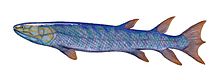
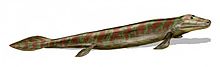
The first major groups of amphibians developed in the Devonian period, around 370 million years ago, from lobe-finned fish which were similar to the modern coelacanth and lungfish.[18] These ancient lobe-finned fish had evolved multi-jointed leg-like fins with digits that enabled them to crawl along the sea bottom. Some fish had developed primitive lungs that help them breathe air when the stagnant pools of the Devonian swamps were low in oxygen. They could also use their strong fins to hoist themselves out of the water and onto dry land if circumstances so required. Eventually, their bony fins would evolve into limbs and they would become the ancestors to all tetrapods, including modern amphibians, reptiles, birds, and mammals. Despite being able to crawl on land, many of these prehistoric tetrapodomorph fish still spent most of their time in the water. They had started to develop lungs, but still breathed predominantly with gills.[19]
Many examples of species showing transitional features have been discovered. Ichthyostega was one of the first primitive amphibians, with nostrils and more efficient lungs. It had four sturdy limbs, a neck, a tail with fins and a skull very similar to that of the lobe-finned fish, Eusthenopteron.[18] Amphibians evolved adaptations that allowed them to stay out of the water for longer periods. Their lungs improved and their skeletons became heavier and stronger, better able to support the weight of their bodies on land. They developed "hands" and "feet" with five or more digits;[20] the skin became more capable of retaining body fluids and resisting desiccation.[19] The fish's hyomandibula bone in the hyoid region behind the gills diminished in size and became the stapes of the amphibian ear, an adaptation necessary for hearing on dry land.[21] An affinity between the amphibians and the teleost fish is the multi-folded structure of the teeth and the paired supra-occipital bones at the back of the head, neither of these features being found elsewhere in the animal kingdom.[22]

At the end of the Devonian period (360 million years ago), the seas, rivers and lakes were teeming with life while the land was the realm of early plants and devoid of vertebrates,[22] though some, such as Ichthyostega, may have sometimes hauled themselves out of the water. It is thought they may have propelled themselves with their forelimbs, dragging their hindquarters in a similar manner to that used by the elephant seal.[20] In the early Carboniferous (360 to 345 million years ago), the climate became wet and warm. Extensive swamps developed with mosses, ferns, horsetails and calamites. Air-breathing arthropods evolved and invaded the land where they provided food for the carnivorous amphibians that began to adapt to the terrestrial environment. There were no other tetrapods on the land and the amphibians were at the top of the food chain, occupying the ecological position currently held by the crocodile. Though equipped with limbs and the ability to breathe air, most still had a long tapering body and strong tail.[22] They were the top land predators, sometimes reaching several metres in length, preying on the large insects of the period and the many types of fish in the water. They still needed to return to water to lay their shell-less eggs, and even most modern amphibians have a fully aquatic larval stage with gills like their fish ancestors. It was the development of the amniotic egg, which prevents the developing embryo from drying out, that enabled the reptiles to reproduce on land and which led to their dominance in the period that followed.[18]
After the Carboniferous rainforest collapse amphibian dominance gave way to reptiles,[23] and amphibians were further devastated by the Permian–Triassic extinction event.[24] During the Triassic Period (250 to 200 million years ago), the reptiles continued to out-compete the amphibians, leading to a reduction in both the amphibians' size and their importance in the biosphere. According to the fossil record, Lissamphibia, which includes all modern amphibians and is the only surviving lineage, may have branched off from the extinct groups Temnospondyli and Lepospondyli at some period between the Late Carboniferous and the Early Triassic. The relative scarcity of fossil evidence precludes precise dating,[19] but the most recent molecular study, based on multilocus sequence typing, suggests a Late Carboniferous/Early Permian origin for extant amphibians.[25]
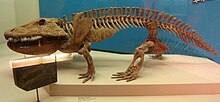
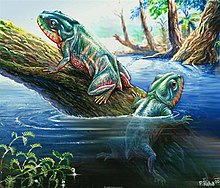
The origins and evolutionary relationships between the three main groups of amphibians is a matter of debate. A 2005 molecular phylogeny, based on rDNA analysis, suggests that salamanders and caecilians are more closely related to each other than they are to frogs. It also appears that the divergence of the three groups took place in the Paleozoic or early Mesozoic (around 250 million years ago), before the breakup of the supercontinent Pangaea and soon after their divergence from the lobe-finned fish. The briefness of this period, and the swiftness with which radiation took place, would help account for the relative scarcity of primitive amphibian fossils.[26] There are large gaps in the fossil record, the discovery of the dissorophoid temnospondyl Gerobatrachus from the Early Permian in Texas in 2008 provided a missing link with many of the characteristics of modern frogs.[13] Molecular analysis suggests that the frog–salamander divergence took place considerably earlier than the palaeontological evidence indicates.[13] One study suggested suggested that the last common ancestor of all modern amphibians lived about 315 million years ago, and that stereospondyl temnospondyls are the closest relatives to the caecilians.[27] However, most studies support a single monophyletic origin of all modern amphibians within the dissorophoid temnospondyls.[4]
As they evolved from lunged fish, amphibians had to make certain adaptations for living on land, including the need to develop new means of locomotion. In the water, the sideways thrusts of their tails had propelled them forward, but on land, quite different mechanisms were required. Their vertebral columns, limbs, limb girdles and musculature needed to be strong enough to raise them off the ground for locomotion and feeding. Terrestrial adults discarded their lateral line systems and adapted their sensory systems to receive stimuli via the medium of the air. They needed to develop new methods to regulate their body heat to cope with fluctuations in ambient temperature. They developed behaviours suitable for reproduction in a terrestrial environment. Their skins were exposed to harmful ultraviolet rays that had previously been absorbed by the water. The skin changed to become more protective and prevent excessive water loss.[28]
Characteristics
The superclass Tetrapoda is divided into four classes of vertebrate animals with four limbs.[29] Reptiles, birds and mammals are amniotes, the eggs of which are either laid or carried by the female and are surrounded by several membranes, some of which are impervious.[30] Lacking these membranes, amphibians require water bodies for reproduction, although some species have developed various strategies for protecting or bypassing the vulnerable aquatic larval stage.[28] They are not found in the sea with the exception of one or two frogs that live in brackish water in mangrove swamps;[31] the Anderson's salamander meanwhile occurs in brackish or salt water lakes.[32] On land, amphibians are restricted to moist habitats because of the need to keep their skin damp.[28]
Modern amphibians have a simplified anatomy compared to their ancestors due to paedomorphosis, caused by two evolutionary trends: miniaturization and an unusually large genome, which result in a slower growth and development rate compared to other vertebrates.[33][34] Another reason for their size is associated with their rapid metamorphosis, which seems to have evolved only in the ancestors of lissamphibia; in all other known lines the development was much more gradual. Because a remodeling of the feeding apparatus means they don't eat during the metamorphosis, the metamorphosis has to go faster the smaller the individual is, so it happens at an early stage when the larvae are still small. (The largest species of salamanders don't go through a metamorphosis.)[35] Amphibians that lay eggs on land often go through the whole metamorphosis inside the egg. An anamniotic terrestrial egg is less than 1 cm in diameter due to diffusion problems, a size which puts a limit on the amount of posthatching growth.[36]
The smallest amphibian (and vertebrate) in the world is a microhylid frog from New Guinea (Paedophryne amauensis) first discovered in 2012. It has an average length of 7.7 mm (0.30 in) and is part of a genus that contains four of the world's ten smallest frog species.[37] The largest living amphibian is the 1.8 m (5 ft 11 in) Chinese giant salamander (Andrias davidianus)[38] but this is a great deal smaller than the largest amphibian that ever existed—the extinct 9 m (30 ft) Prionosuchus, a crocodile-like temnospondyl dating to 270 million years ago from the middle Permian of Brazil.[39] The largest frog is the African Goliath frog (Conraua goliath), which can reach 32 cm (13 in) and weigh 3 kg (6.6 lb).[38]
Amphibians are ectothermic (cold-blooded) vertebrates that do not maintain their body temperature through internal physiological processes. Their metabolic rate is low and as a result, their food and energy requirements are limited. In the adult state, they have tear ducts and movable eyelids, and most species have ears that can detect airborne or ground vibrations. They have muscular tongues, which in many species can be protruded. Modern amphibians have fully ossified vertebrae with articular processes. Their ribs are usually short and may be fused to the vertebrae. Their skulls are mostly broad and short, and are often incompletely ossified. Their skin contains little keratin and lacks scales, apart from a few fish-like scales in certain caecilians. The skin contains many mucous glands and in some species, poison glands (a type of granular gland). The hearts of amphibians have three chambers, two atria and one ventricle. They have a urinary bladder and nitrogenous waste products are excreted primarily as urea. Most amphibians lay their eggs in water and have aquatic larvae that undergo metamorphosis to become terrestrial adults. Amphibians breathe by means of a pump action in which air is first drawn into the buccopharyngeal region through the nostrils. These are then closed and the air is forced into the lungs by contraction of the throat.[40] They supplement this with gas exchange through the skin.[28]
Anura
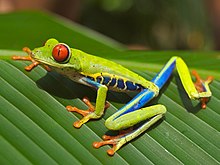
The order Anura (from the Ancient Greek a(n)- meaning "without" and oura meaning "tail") comprises the frogs and toads. They usually have long hind limbs that fold underneath them, shorter forelimbs, webbed toes with no claws, no tails, large eyes and glandular moist skin.[12] Members of this order with smooth skins are commonly referred to as frogs, while those with warty skins are known as toads. The difference is not a formal one taxonomically and there are numerous exceptions to this rule. Members of the family Bufonidae are known as the "true toads".[41] Frogs range in size from the 30-centimetre (12 in) Goliath frog (Conraua goliath) of West Africa[42] to the 7.7-millimetre (0.30 in) Paedophryne amauensis, first described in Papua New Guinea in 2012, which is also the smallest known vertebrate.[43] Although most species are associated with water and damp habitats, some are specialised to live in trees or in deserts. They are found worldwide except for polar areas.[44]
Anura is divided into three suborders that are broadly accepted by the scientific community, but the relationships between some families remain unclear. Future molecular studies should provide further insights into their evolutionary relationships.[45] The suborder Archaeobatrachia contains four families of primitive frogs. These are Ascaphidae, Bombinatoridae, Discoglossidae and Leiopelmatidae which have few derived features and are probably paraphyletic with regard to other frog lineages.[46] The six families in the more evolutionarily advanced suborder Mesobatrachia are the fossorial Megophryidae, Pelobatidae, Pelodytidae, Scaphiopodidae and Rhinophrynidae and the obligatorily aquatic Pipidae. These have certain characteristics that are intermediate between the two other suborders.[46] Neobatrachia is by far the largest suborder and includes the remaining families of modern frogs, including most common species. Ninety-six percent of the over 5,000 extant species of frog are neobatrachians.[47]
Caudata
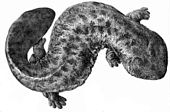
(Andrias japonicus), a primitive salamander
The order Caudata (from the Latin cauda meaning "tail") consists of the salamanders—elongated, low-slung animals that mostly resemble lizards in form. This is a symplesiomorphic trait and they are no more closely related to lizards than they are to mammals.[48] Salamanders lack claws, have scale-free skins, either smooth or covered with tubercles, and tails that are usually flattened from side to side and often finned. They range in size from the Chinese giant salamander (Andrias davidianus), which has been reported to grow to a length of 1.8 metres (5 ft 11 in),[49] to the diminutive Thorius pennatulus from Mexico which seldom exceeds 20 mm (0.8 in) in length.[50] Salamanders have a mostly Laurasian distribution, being present in much of the Holarctic region of the northern hemisphere. The family Plethodontidae is also found in Central America and South America north of the Amazon basin;[44] South America was apparently invaded from Central America by about the start of the Miocene, 23 million years ago.[51] Urodela is a name sometimes used for all the extant species of salamanders.[52] Members of several salamander families have become paedomorphic and either fail to complete their metamorphosis or retain some larval characteristics as adults.[53] Most salamanders are under 15 cm (6 in) long. They may be terrestrial or aquatic and many spend part of the year in each habitat. When on land, they mostly spend the day hidden under stones or logs or in dense vegetation, emerging in the evening and night to forage for worms, insects and other invertebrates.[44]

(Triturus dobrogicus), an advanced salamander
The suborder Cryptobranchoidea contains the primitive salamanders. A number of fossil cryptobranchids have been found, but there are only three living species, the Chinese giant salamander (Andrias davidianus), the Japanese giant salamander (Andrias japonicus) and the hellbender (Cryptobranchus alleganiensis) from North America. These large amphibians retain several larval characteristics in their adult state; gills slits are present and the eyes are unlidded. A unique feature is their ability to feed by suction, depressing either the left side of their lower jaw or the right.[54] The males excavate nests, persuade females to lay their egg strings inside them, and guard them. As well as breathing with lungs, they respire through the many folds in their thin skin, which has capillaries close to the surface.[55]
The suborder Salamandroidea contains the advanced salamanders. They differ from the cryptobranchids by having fused prearticular bones in the lower jaw, and by using internal fertilisation. In salamandrids, the male deposits a bundle of sperm, the spermatophore, and the female picks it up and inserts it into her cloaca where the sperm is stored until the eggs are laid.[56] The largest family in this group is Plethodontidae, the lungless salamanders, which includes 60% of all salamander species. The family Salamandridae includes the true salamanders and the name "newt" is given to members of its subfamily Pleurodelinae.[12]
The third suborder, Sirenoidea, contains the four species of sirens, which are in a single family, Sirenidae. Members of this order are eel-like aquatic salamanders with much reduced forelimbs and no hind limbs. Some of their features are primitive while others are derived.[57] Fertilisation is likely to be external as sirenids lack the cloacal glands used by male salamandrids to produce spermatophores and the females lack spermathecae for sperm storage. Despite this, the eggs are laid singly, a behaviour not conducive for external fertilisation.[56]
Gymnophiona

The order Gymnophiona (from the Greek gymnos meaning "naked" and ophis meaning "serpent") or Apoda comprises the caecilians. These are long, cylindrical, limbless animals with a snake- or worm-like form. The adults vary in length from 8 to 75 centimetres (3 to 30 inches) with the exception of Thomson's caecilian (Caecilia thompsoni), which can reach 150 centimetres (4.9 feet). A caecilian's skin has a large number of transverse folds and in some species contains tiny embedded dermal scales. It has rudimentary eyes covered in skin, which are probably limited to discerning differences in light intensity. It also has a pair of short tentacles near the eye that can be extended and which have tactile and olfactory functions. Most caecilians live underground in burrows in damp soil, in rotten wood and under plant debris, but some are aquatic.[58] Most species lay their eggs underground and when the larvae hatch, they make their way to adjacent bodies of water. Others brood their eggs and the larvae undergo metamorphosis before the eggs hatch. A few species give birth to live young, nourishing them with glandular secretions while they are in the oviduct.[59] Caecilians have a mostly Gondwanan distribution, being found in tropical regions of Africa, Asia and Central and South America.[60]