Crocodiles (family Crocodylidae) or true crocodiles are large semiaquatic reptiles that live throughout the tropics in Africa, Asia, the Americas and Australia. The term crocodile is sometimes used even more loosely to include all extant members of the order Crocodilia, which includes the alligators and caimans (family Alligatoridae), the gharial and false gharial (family Gavialidae) among other extinct taxa.
Crocodiles
Temporal range: Eocene– Holocene, 46–0 Ma |
|---|
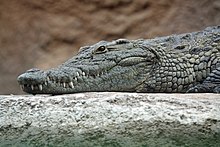 |
| Nile crocodile (Crocodylus niloticus) |
 |
| Saltwater crocodile (Crocodylus porosus) |
Scientific classification |
|---|
| Kingdom: | Animalia |
| Phylum: | Chordata |
| Class: | Reptilia |
| Order: | Crocodilia |
| Superfamily: | Crocodyloidea |
| Family: | Crocodylidae
Cuvier, 1807 |
| Type genus |
|---|
Crocodylus
Laurenti, 1768 |
| Subfamilies |
|---|
- Crocodylinae
- Osteolaeminae
|
Although they appear similar, crocodiles, alligators and the gharial belong to separate biological families. The gharial, with its narrow snout, is easier to distinguish, while morphological differences are more difficult to spot in crocodiles and alligators. The most obvious external differences are visible in the head, with crocodiles having narrower and longer heads, with a more V-shaped than a U-shaped snout compared to alligators and caimans. Another obvious trait is that the upper and lower jaws of the crocodiles are the same width, and the teeth in the lower jaw fall along the edge or outside the upper jaw when the mouth is closed; therefore, all teeth are visible, unlike an alligator, which possesses in the upper jaw small depressions into which the lower teeth fit. Also, when the crocodile's mouth is closed, the large fourth tooth in the lower jaw fits into a constriction in the upper jaw. For hard-to-distinguish specimens, the protruding tooth is the most reliable feature to define the species' family.[1] Crocodiles have more webbing on the toes of the hind feet and can better tolerate saltwater due to specialized salt glands for filtering out salt, which are present, but non-functioning, in alligators. Another trait that separates crocodiles from other crocodilians is their much higher levels of aggression.[2]
Crocodile size, morphology, behaviour and ecology differ somewhat among species. However, they have many similarities in these areas as well. All crocodiles are semiaquatic and tend to congregate in freshwater habitats such as rivers, lakes, wetlands and sometimes in brackish water and saltwater. They are carnivorous animals, feeding mostly on vertebrates such as fish, reptiles, birds and mammals, and sometimes on invertebrates such as molluscs and crustaceans, depending on species and age. All crocodiles are tropical species that, unlike alligators, are very sensitive to cold. They separated from other crocodilians during the Eocene epoch, about 55 million years ago.[3] Many species are at the risk of extinction, some being classified as critically endangered.
EtymologyThe word crocodile comes from the Ancient Greek krokódilos (κροκόδιλος) meaning 'lizard', used in the phrase ho krokódilos tou potamoú, "the lizard of the (Nile) river". There are several variant Greek forms of the word attested, including the later form krokódeilos (κροκόδειλος)[4] found cited in many English reference works.[5] In the Koine Greek of Roman times, krokodilos and krokodeilos would have been pronounced identically, and either or both may be the source of the Latinized form crocodīlus used by the ancient Romans. It has been suggested, but it is not certain that the word crocodilos or crocodeilos is a compound of krokè ('pebbles'), and drilos/dreilos ('worm'), although drilos is only attested as a colloquial term for 'penis'.[5] It is ascribed to Herodotus, and supposedly describes the basking habits of the Egyptian crocodile.[6]
The form crocodrillus is attested in Medieval Latin.[5] It is not clear whether this is a medieval corruption or derives from alternative Greco-Latin forms (late Greek corcodrillos and corcodrillion are attested). A (further) corrupted form cocodrille is found in Old French and was borrowed into Middle English as cocodril(le). The Modern English form crocodile was adapted directly from the Classical Latin crocodīlus in the 16th century, replacing the earlier form. The use of -y- in the scientific name Crocodylus (and forms derived from it) is a corruption introduced by Laurenti (1768).
Species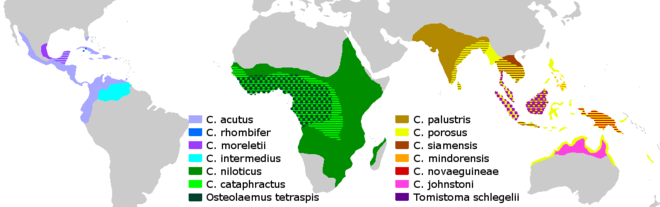
Distribution of crocodiles
A total of 18 extant species have been recognized. Further genetic study is needed for the confirmation of proposed species under the genus Osteolaemus.
| Species name | Image | Distribution | Description/Comments |
|---|
| American crocodile (Crocodylus acutus) |  | Throughout the Caribbean Basin, including many of the Caribbean islands and South Florida. | A larger sized species, with a greyish colour and a prominent V-shaped snout. Prefers brackish water, but also inhabits lower stretches of rivers and true marine environments. This is one of the rare species that exhibits regular sea-going behaviour, which explains the great distribution throughout the Caribbean. It is also found in hypersaline lakes such as Lago Enriquillo, in the Dominican Republic, which has one of the largest populations of this species.[7] Diet consists mostly of aquatic and terrestrial vertebrates. Classified as Vulnerable, but certain local populations under greater threat. |
| Hall's New Guinea crocodile (Crocodylus halli) | | The island of New Guinea, south of the New Guinea Highlands | A smaller species that closely resembles and was long classified under the New Guinea crocodile, which it is now considered to be genetically distinct from. It lives south of the mountain barrier that divides the two species' ranges. It can be physically distinguished from the New Guinea crocodile by its shorter maxilla and enlarged postcranial elements. Cranial elements can still widely vary within the species, with populations from Lake Murray having much wider heads than those from the Aramia River.[8] |
| Orinoco crocodile (Crocodylus intermedius) | 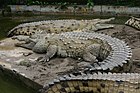 | Colombia and Venezuela | This is a large species with a relatively elongated snout and a pale tan coloration with scattered dark brown markings. Lives primarily in the Orinoco Basin. Despite having a rather narrow snout, preys on a wide variety of vertebrates, including large mammals. It is a Critically Endangered species. |
| Freshwater crocodile (Crocodylus johnstoni) |  | Northern Australia | A smaller species with a narrow and elongated snout. It has light brown coloration with darker bands on body and tail. Lives in rivers with considerable distance from the sea, to avoid confrontations with saltwater crocodiles. Feeds mostly on fish and other small vertebrates. |
| Philippine crocodile (Crocodylus mindorensis) |  | Endemic to the Philippines | This is a relatively small species with a rather broader snout. It has heavy dorsal armour and a golden-brown colour that darkens as the animal matures. Prefers freshwater habitats and feeds on a variety of small to medium sized vertebrates. This species is Critically Endangered and the most severely threatened species of crocodile.[9] |
| Morelet's crocodile (Crocodylus moreletii) |  | Atlantic regions of Mexico, Belize and Guatemala | A small to medium sized crocodile with a rather broad snout. It has a dark greyish-brown colour and is found in mostly various freshwater habitats. Feeds on mammals, birds and reptiles. It is listed as Least Concern. |
| Nile crocodile (Crocodylus niloticus) |  | Sub-saharan Africa | A large and aggressive species with a broad snout, especially in older animals. It has a dark bronze coloration and darkens as the animal matures. Lives in a variety of freshwater habitats but is also found in brackish water. It is an apex predator that is capable of taking a wide array of African vertebrates, including large ungulates and other predators.[10] This species is listed as Least Concern. |
| New Guinea crocodile (Crocodylus novaeguineae) |  | The island of New Guinea, north of the New Guinea Highlands | A smaller species of crocodile with a grey-brown colour and dark brown to black markings on the tail. The young have a narrower V-shaped snout that becomes wider as the animal matures. Prefers freshwater habitats, even though is tolerant to salt water, in order to avoid competition and predation by the saltwater crocodile. This species feeds on small to mid-sized vertebrates. |
| Mugger crocodile (Crocodylus palustris) |  | The Indian subcontinent and surrounding countries | This is a modest sized crocodile with a very broad snout and an alligator-like appearance. It has dark-grey to brown coloration. Enlarged scutes around the neck make it a heavily armoured species. Prefers slow moving rivers, swamps and lakes. It can also be found in coastal swamps but avoids areas populated by saltwater crocodiles.[11] Feeds on a wide array of vertebrates. |
| Saltwater crocodile (Crocodylus porosus) |  | Throughout Southeast Asia, Northern Australia and surrounding waters | The largest living reptile and most aggressive of all crocodiles. It is a big-headed species and has a relatively broad snout, especially when older. The coloration is pale yellow with black stripes when young but dark greenish-drab coloured as adults. Lives in brackish and marine environments as well as lower stretches of rivers. This species has the greatest distribution of all crocodiles. Tagged specimens showed long-distance marine travelling behaviour. It is the apex predator throughout its range and preys on virtually any animal within its reach. It is classified as Least Concern with several populations under greater risk.[12] |
| Borneo crocodile (Crocodylus raninus) | | Island of Borneo in Southeast Asia | A freshwater species of crocodile that has been considered a synonym of the saltwater crocodile. |
| Cuban crocodile (Crocodylus rhombifer) |  | Found only in the Zapata Swamp and Isle of Youth of Cuba | It is a small but extremely aggressive species of crocodile that prefers freshwater swamps.[13] The coloration is vibrant even as adults and the scales have a "pebbled" appearance. It is a relatively terrestrial species with agile locomotion on land, and sometimes displays terrestrial hunting. The snout is broad with a thick upper-jaw and large teeth. The unique characteristics and fossil record indicates a rather specialized diet in the past, preying on megafauna such as the giant sloth. This species sometimes displays pack-hunting behaviour, which might have been the key to hunting large species in the past, despite its small size.[14] Today most prey are small to medium sized vertebrates. It is Critically Endangered, and the remaining wild population is under threat of hybridization.[15] |
| Siamese crocodile (Crocodylus siamensis) |  | Indonesia, Brunei, East Malaysia and southern Indochina | A fairly small crocodile that prefers freshwater habitats. It has a relatively broad snout and olive-green to dark green coloration. It feeds on a variety of small to mid-sized vertebrates. Listed as Critically Endangered, but might be already extinct in the wild; status is unknown.[16] |
| West African crocodile (Crocodylus suchus) |  | Western and Central Africa | Recent studies revealed that this is distinct species from the larger Nile crocodile.[17][18] It has a slightly narrower snout and is much smaller compared to its larger cousin. |
| Osborn’s dwarf crocodile (Osteolaemus osborni) | | Western Africa | It is the smallest of all living crocodiles. It is a heavily armoured species with uniform black coloration in adults, while juveniles have a lighter brown banding. Lives in the tropical forests of Western Africa. Feeds on small vertebrates and large aquatic invertebrates. It is a fairly terrestrial species and exhibits terrestrial hunting, especially at night. |
| Dwarf crocodile (Osteolaemus tetraspis) |  | Western Africa | It is the smallest of all living crocodiles. It belongs to its own monotypic genus; however, new studies indicate there might be two or even three distinct species.[19] It is a heavily armoured species with uniform black coloration in adults, while juveniles have a lighter brown banding. Lives in the tropical forests of Western Africa. Feeds on small vertebrates and large aquatic invertebrates. It is a fairly terrestrial species and exhibits terrestrial hunting, especially at night. This species is classified as Vulnerable. |
| West African slender-snouted crocodile (Mecistops cataphractus) |  | Western Africa | A medium sized species with a narrow and elongated snout. Lives in freshwater habitats within tropical forests of the continent. Feeds mostly on fish but also other small to medium sized vertebrates. It is a Critically Endangered species. |
| Central African slender-snouted crocodile (Mecistops leptorhynchus) |  | Central Africa | A medium sized species found in watery areas in dense rainforest. Feeds largely on fish. Insufficient conservation data, but was classified as Critically Endangered when lumped with M. cataphractus, although M. leptorhynchus is doing better in its home range. |
For information on Tomistoma or false gharial, that is recently not considered as a true crocodile, see False gharial.
CharacteristicsCrocodiles are similar to alligators and caimans; for their common characteristics and differences among them, see Crocodilia.

Skulls and scutes of American, Nile and Saltwater crocodiles, with post-occipital scutes highlighted in red, nuchal shield in blue and dorsal scutes in green

Crocodiles, like dinosaurs, have the abdominal ribs modified into gastralia.
A crocodile's physical traits allow it to be a successful predator. Its external morphology is a sign of its aquatic and predatory lifestyle. Its streamlined body enables it to swim swiftly; it also tucks its feet to the side while swimming, making it faster by decreasing water resistance. Crocodiles have webbed feet which, though not used to propel them through the water, allow them to make fast turns and sudden moves in the water or initiate swimming. Webbed feet are an advantage in shallow water, where the animals sometimes move around by walking. Crocodiles have a palatal flap, a rigid tissue at the back of the mouth that blocks the entry of water. The palate has a special path from the nostril to the glottis that bypasses the mouth. The nostrils are closed during submergence.
Like other archosaurs, crocodilians are diapsid, although their post-temporal fenestrae are reduced. The walls of the braincase are bony but lack supratemporal and postfrontal bones.[20] Their tongues are not free, but held in place by a membrane that limits movement; as a result, crocodiles are unable to stick out their tongues.[21] Crocodiles have smooth skin on their bellies and sides, while their dorsal surfaces are armoured with large osteoderms. The armoured skin has scales and is thick and rugged, providing some protection. They are still able to absorb heat through this armour, as a network of small capillaries allows blood through the scales to absorb heat. The osteoderms are highly vascularised and aid in calcium balance, both to neutralize acids while the animal cannot breathe underwater[22] and to provide calcium for eggshell formation.[23] Crocodilian tegument have pores believed to be sensory in function, analogous to the lateral line in fishes. They are particularly seen on their upper and lower jaws. Another possibility is that they are secretory, as they produce an oily substance which appears to flush mud off.[20]
Size

A saltwater crocodile in captivity
Size greatly varies among species, from the dwarf crocodile to the saltwater crocodile. Species of the dwarf crocodile Osteolaemus grow to an adult size of just 1.5 to 1.9 m (4.9 to 6.2 ft),[24] whereas the saltwater crocodile can grow to sizes over 6 m (20 ft) and weigh over 1,000 kg (2,200 lb).[25] Several other large species can reach over 5.2 m (17 ft) long and weigh over 900 kg (2,000 lb). Crocodilians show pronounced sexual dimorphism, with males growing much larger and more rapidly than females.[20] Despite their large adult sizes, crocodiles start their lives at around 20 cm (7.9 in) long. The largest species of crocodile is the saltwater crocodile, found in eastern India, northern Australia, throughout South-east Asia, and in the surrounding waters.
The brain volume of two adult crocodiles was 5.6 cm3 for a spectacled caiman and 8.5 cm3 for a larger Nile crocodile.[26]
The largest crocodile ever held in captivity is a saltwater–Siamese hybrid named Yai (Thai: ใหญ่, meaning big; born 10 June 1972) at the Samutprakarn Crocodile Farm and Zoo, Thailand. This animal measures 6 m (20 ft) in length and weighs 1,200 kg (2,600 lb).[27]
The longest crocodile captured alive was Lolong, a saltwater crocodile which was measured at 6.17 m (20.2 ft) and weighed at 1,075 kg (2,370 lb) by a National Geographic team in Agusan del Sur Province, Philippines.[28][29][30]
Teeth
Crocodiles are polyphyodonts; they are able to replace each of their 80 teeth up to 50 times in their 35- to 75-year lifespan.[31][32] Next to each full-grown tooth, there is a small replacement tooth and an odontogenic stem cell in the dental lamina in standby that can be activated if required.[33]