Snakes are elongated, limbless, carnivorous reptiles of the suborder Serpentes /sɜːrˈpɛntiːz/.[2] Like all other squamates, snakes are ectothermic, amniote vertebrates covered in overlapping scales. Many species of snakes have skulls with several more joints than their lizard ancestors, enabling them to swallow prey much larger than their heads (cranial kinesis). To accommodate their narrow bodies, snakes' paired organs (such as kidneys) appear one in front of the other instead of side by side, and most have only one functional lung. Some species retain a pelvic girdle with a pair of vestigial claws on either side of the cloaca. Lizards have evolved elongate bodies without limbs or with greatly reduced limbs about twenty-five times independently via convergent evolution, leading to many lineages of legless lizards.[3] These resemble snakes, but several common groups of legless lizards have eyelids and external ears, which snakes lack, although this rule is not universal (see Amphisbaenia, Dibamidae, and Pygopodidae).
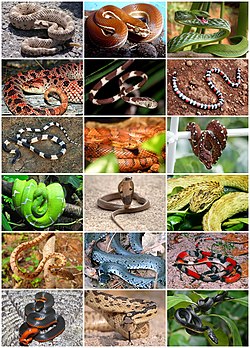


Living snakes are found on every continent except Antarctica, and on most smaller land masses; exceptions include some large islands, such as Ireland, Iceland, Greenland, the Hawaiian archipelago, and the islands of New Zealand, as well as many small islands of the Atlantic and central Pacific oceans.[4] Additionally, sea snakes are widespread throughout the Indian and Pacific oceans. More than twenty families are currently recognized, comprising about 520 genera and about 3,900 species.[5] They range in size from the tiny, 10.4 cm-long (4.1 in) Barbados threadsnake[6] to the reticulated python of 6.95 meters (22.8 ft) in length.[7] The fossil species Titanoboa cerrejonensis was 12.8 meters (42 ft) long.[8] Snakes are thought to have evolved from either burrowing or aquatic lizards, perhaps during the Jurassic period, with the earliest known fossils dating to between 143 and 167 Ma ago.[9][10] The diversity of modern snakes appeared during the Paleocene epoch (c. 66 to 56 Ma ago, after the Cretaceous–Paleogene extinction event). The oldest preserved descriptions of snakes can be found in the Brooklyn Papyrus.
Most species of snake are nonvenomous and those that have venom use it primarily to kill and subdue prey rather than for self-defense. Some possess venom that is potent enough to cause painful injury or death to humans. Nonvenomous snakes either swallow prey alive or kill by constriction.
Etymology
The English word snake comes from Old English snaca, itself from Proto-Germanic *snak-an- (cf. Germanic Schnake 'ring snake', Swedish snok 'grass snake'), from Proto-Indo-European root *(s)nēg-o- 'to crawl to creep', which also gave sneak as well as Sanskrit nāgá 'snake'.[11] The word ousted adder, as adder went on to narrow in meaning, though in Old English næddre was the general word for snake.[12] The other term, serpent, is from French, ultimately from Indo-European *serp- 'to creep',[13] which also gave Ancient Greek ἕρπω (hérpō) 'I crawl'.
Evolution
The fossil record of snakes is relatively poor because snake skeletons are typically small and fragile making fossilization uncommon. Fossils readily identifiable as snakes (though often retaining hind limbs) first appear in the fossil record during the Cretaceous period.[15] The earliest known true snake fossils (members of the crown group Serpentes) come from the marine simoliophiids, the oldest of which is the Late Cretaceous (Cenomanian age) Haasiophis terrasanctus,[1] dated to between 112 and 94 million years old.[16]
Based on comparative anatomy, there is consensus that snakes descended from lizards.[17]: 11 [18] Pythons and boas—primitive groups among modern snakes—have vestigial hind limbs: tiny, clawed digits known as anal spurs, which are used to grasp during mating.[17]: 11 [19] The families Leptotyphlopidae and Typhlopidae also possess remnants of the pelvic girdle, appearing as horny projections when visible.
Front limbs are nonexistent in all known snakes. This is caused by the evolution of their Hox genes, controlling limb morphogenesis. The axial skeleton of the snakes' common ancestor, like most other tetrapods, had regional specializations consisting of cervical (neck), thoracic (chest), lumbar (lower back), sacral (pelvic), and caudal (tail) vertebrae. Early in snake evolution, the Hox gene expression in the axial skeleton responsible for the development of the thorax became dominant. As a result, the vertebrae anterior to the hindlimb buds (when present) all have the same thoracic-like identity (except from the atlas, axis, and 1–3 neck vertebrae). In other words, most of a snake's skeleton is an extremely extended thorax. Ribs are found exclusively on the thoracic vertebrae. Neck, lumbar and pelvic vertebrae are very reduced in number (only 2–10 lumbar and pelvic vertebrae are present), while only a short tail remains of the caudal vertebrae. However, the tail is still long enough to be of important use in many species, and is modified in some aquatic and tree-dwelling species.
Many modern snake groups originated during the Paleocene, alongside the adaptive radiation of mammals following the extinction of (non-avian) dinosaurs. The expansion of grasslands in North America also led to an explosive radiation among snakes.[20] Previously, snakes were a minor component of the North American fauna, but during the Miocene, the number of species and their prevalence increased dramatically with the first appearances of vipers and elapids in North America and the significant diversification of Colubridae (including the origin of many modern genera such as Nerodia, Lampropeltis, Pituophis, and Pantherophis).[20]
Fossils
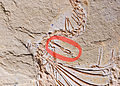
There is fossil evidence to suggest that snakes may have evolved from burrowing lizards,[21] during the Cretaceous Period.[22] An early fossil snake relative, Najash rionegrina, was a two-legged burrowing animal with a sacrum, and was fully terrestrial.[23] One extant analog of these putative ancestors is the earless monitor Lanthanotus of Borneo (though it also is semiaquatic).[24] Subterranean species evolved bodies streamlined for burrowing, and eventually lost their limbs.[24] According to this hypothesis, features such as the transparent, fused eyelids (brille) and loss of external ears evolved to cope with fossorial difficulties, such as scratched corneas and dirt in the ears.[22][24] Some primitive snakes are known to have possessed hindlimbs, but their pelvic bones lacked a direct connection to the vertebrae. These include fossil species like Haasiophis, Pachyrhachis and Eupodophis, which are slightly older than Najash.[19]
This hypothesis was strengthened in 2015 by the discovery of a 113-million-year-old fossil of a four-legged snake in Brazil that has been named Tetrapodophis amplectus. It has many snake-like features, is adapted for burrowing and its stomach indicates that it was preying on other animals.[25] It is currently uncertain if Tetrapodophis is a snake or another species, in the squamate order, as a snake-like body has independently evolved at least 26 times. Tetrapodophis does not have distinctive snake features in its spine and skull.[26][27] A study in 2021 places the animal in a group of extinct marine lizards from the Cretaceous period known as dolichosaurs and not directly related to snakes.[28]
An alternative hypothesis, based on morphology, suggests the ancestors of snakes were related to mosasaurs—extinct aquatic reptiles from the Cretaceous—forming the clade Pythonomorpha.[18] According to this hypothesis, the fused, transparent eyelids of snakes are thought to have evolved to combat marine conditions (corneal water loss through osmosis), and the external ears were lost through disuse in an aquatic environment. This ultimately led to an animal similar to today's sea snakes. In the Late Cretaceous, snakes recolonized land, and continued to diversify into today's snakes. Fossilized snake remains are known from early Late Cretaceous marine sediments, which is consistent with this hypothesis; particularly so, as they are older than the terrestrial Najash rionegrina. Similar skull structure, reduced or absent limbs, and other anatomical features found in both mosasaurs and snakes lead to a positive cladistical correlation, although some of these features are shared with varanids.[citation needed]
Genetic studies in recent years have indicated snakes are not as closely related to monitor lizards as was once believed—and therefore not to mosasaurs, the proposed ancestor in the aquatic scenario of their evolution. However, more evidence links mosasaurs to snakes than to varanids. Fragmented remains found from the Jurassic and Early Cretaceous indicate deeper fossil records for these groups, which may potentially refute either hypothesis.[29][30]



Genetic basis of snake evolution
Both fossils and phylogenetic studies demonstrate that snakes evolved from lizards, hence the question became which genetic changes led to limb loss in the snake ancestor. Limb loss is actually very common in extant reptiles and has happened dozens of times within skinks, anguids, and other lizards.[31]
In 2016, two studies reported that limb loss in snakes is associated with DNA mutations in the Zone of Polarizing Activity Regulatory Sequence (ZRS), a regulatory region of the sonic hedgehog gene which is critically required for limb development. More advanced snakes have no remnants of limbs, but basal snakes such as pythons and boas do have traces of highly reduced, vestigial hind limbs. Python embryos even have fully developed hind limb buds, but their later development is stopped by the DNA mutations in the ZRS.[32][33][34][35]
Distribution
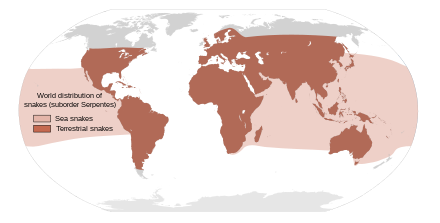
There are about 3,900 species of snakes,[36] ranging as far northward as the Arctic Circle in Scandinavia and southward through Australia.[18] Snakes can be found on every continent except Antarctica, as well as in the sea, and as high as 16,000 feet (4,900 m) in the Himalayan Mountains of Asia.[18][37]: 143 There are numerous islands from which snakes are absent, such as Ireland, Iceland, and New Zealand[4][37] (although New Zealand's waters are infrequently visited by the yellow-bellied sea snake and the banded sea krait).[38]
Taxonomy
All modern snakes are grouped within the suborder Serpentes in Linnean taxonomy, part of the order Squamata, though their precise placement within squamates remains controversial.[39]
The two infraorders of Serpentes are: Alethinophidia and Scolecophidia.[39] This separation is based on morphological characteristics and mitochondrial DNA sequence similarity. Alethinophidia is sometimes split into Henophidia and Caenophidia, with the latter consisting of "colubroid" snakes (colubrids, vipers, elapids, hydrophiids, and atractaspids) and acrochordids, while the other alethinophidian families comprise Henophidia.[40] While not extant today, the Madtsoiidae, a family of giant, primitive, python-like snakes, was around until 50,000 years ago in Australia, represented by genera such as Wonambi.
There are numerous debates in the systematics within the group. For instance, many sources classify Boidae and Pythonidae as one family, while some keep the Elapidae and Hydrophiidae (sea snakes) separate for practical reasons despite their extremely close relation.
Recent molecular studies support the monophyly of the clades of modern snakes, scolecophidians, typhlopids + anomalepidids, alethinophidians, core alethinophidians, uropeltids (Cylindrophis, Anomochilus, uropeltines), macrostomatans, booids, boids, pythonids and caenophidians.[14]
Families
Legless lizards
While snakes are limbless reptiles, evolved from (and grouped with) lizards, there are many other species of lizards that have lost their limbs independently but which superficially look similar to snakes. These include the slowworm and glass snake.
Other serpentine tetrapods that are unrelated to snakes include caecilians (amphibians), amphisbaenians (near-lizard squamates), and the extinct aistopods (amphibians).