Tuatara (Sphenodon punctatus) are reptiles endemic to New Zealand. Despite their close resemblance to lizards, they are part of a distinct lineage, the order Rhynchocephalia.[7] The name tuatara is derived from the Māori language and means "peaks on the back".[8] The single extant species of tuatara is the only surviving member of its order.[9] Rhynchocephalus originated during the Triassic (~250 million years ago), reached worldwide distribution and peak diversity during the Jurassic and, with the exception of tuatara, were extinct by 60 million years ago.[10][11][12] Their closest living relatives are squamates (lizards and snakes).[13] For this reason, tuatara are of interest in the study of the evolution of lizards and snakes, and for the reconstruction of the appearance and habits of the earliest diapsids, a group of amniote tetrapods that also includes dinosaurs (including birds) and crocodilians.



Tuatara are greenish brown and grey, and measure up to 80 cm (31 in) from head to tail-tip and weigh up to 1.3 kg (2.9 lb)[14] with a spiny crest along the back, especially pronounced in males. They have two rows of teeth in the upper jaw overlapping one row on the lower jaw, which is unique among living species. They are able to hear, although no external ear is present, and have unique features in their skeleton, some of them apparently evolutionarily retained from fish.
Tuatara are sometimes referred to as "living fossils",[7] which has generated significant scientific debate. This term is currently deprecated among paleontologists and evolutionary biologists. Although tuatara have preserved the morphological characteristics of their Mesozoic ancestors (240–230 million years ago), there is no evidence of a continuous fossil record to support this.[15][16][17][18][19][20][21][22][23][24] The species has between 5 and 6 billion base pairs of DNA sequence, nearly twice that of humans.[25]
The tuatara (Sphenodon punctatus) has been protected by law since 1895.[26][27] A second species, the Brothers Island tuatara S. guntheri, (Buller, 1877), was recognised in 1989,[14] but since 2009 it has been reclassified as a subspecies (S.p. guntheri).[28][29] Tuatara, like many of New Zealand's native animals, are threatened by habitat loss and introduced predators, such as the Polynesian rat (Rattus exulans). Tuatara were extinct on the mainland, with the remaining populations confined to 32 offshore islands[12] until the first North Island release into the heavily fenced and monitored Karori Wildlife Sanctuary (now named "Zealandia") in 2005.[30]
During routine maintenance work at Zealandia in late 2008, a tuatara nest was uncovered,[31] with a hatchling found the following autumn.[32] This is thought to be the first case of tuatara successfully breeding in the wild on New Zealand's North Island in over 200 years.
Description

Adult S. punctatus males measure 61 cm (24 in) in length and females 45 cm (18 in).[33] Tuatara are sexually dimorphic, males being larger.[33] The San Diego Zoo even cites a length of up to 80 cm (31 in).[34] Males weigh up to 1 kg (2.2 lb), and females up to 0.5 kg (1.1 lb).[33] Brother's Island tuatara are slightly smaller, weighing up to 660 g (1.3 lb).[35]
Their lungs have a single chamber with no bronchi.[36]
The tuatara's greenish brown colour matches its environment, and can change over its lifetime. Tuatara shed their skin at least once per year as adults,[37] and three or four times a year as juveniles. Tuatara sexes differ in more than size. The spiny crest on a tuatara's back, made of triangular, soft folds of skin, is larger in males, and can be stiffened for display. The male abdomen is narrower than the female's.[38]

- premaxilla
- nasal
- prefrontal
- frontal
- maxilla
- postfrontal
- dentary
- postorbital
- jugal
- parietal
- squamosal
- quadrate
Skull
The ancestor of diapsids had a skull with two openings in the temporal region – upper and lower temporal fenestra on each side of the skull bounded by complete arches. The upper jaw is firmly attached to the posterior of skull.[33] This makes for a very rigid, inflexible construction. The skull of the tuatara has a similar structure.[9] However, the lower temporal bar (sometimes called the cheek bone) is incomplete in some fossil Rhynchocephalia, indicating that its presence in the tuatara is a distinctive (autapomorphic) feature rather than one inherited from a common ancestor.[39]
The tip of the upper jaw is beak-like and separated from the remainder of the jaw by a notch.[9] There is a single row of teeth in the lower jaw and a double row in the upper, with the bottom row fitting perfectly between the two upper rows when the mouth is closed.[9] This specific tooth arrangement is not seen in any other reptile;[9] although most snakes have a double row of teeth in their upper jaws, their arrangement and function is different from the tuatara's.
The structure of the jaw joint allows the lower jaw to slide forwards after it has closed between the two upper rows of teeth.[40] This mechanism allows the jaws to shear through chitin and bone. [33] Fossils indicate that the jaw mechanism began evolving at least 200 million years ago.[41] The teeth are not replaced. As their teeth wear down, older tuatara have to switch to softer prey such as earthworms, larvae, and slugs, and eventually have to chew their food between smooth jaw bones.[42] It is a common misconception that tuatara lack teeth and instead have sharp projections on the jaw bone,[43] though histology shows that they have enamel and dentine with pulp cavities.[44]
The brain of Sphenodon fills only half of the volume of its endocranium.[45] This proportion has actually been used by paleontologists trying to estimate the volume of dinosaur brains based on fossils.[45] However, the proportion of the tuatara endocranium occupied by its brain may not be a very good guide to the same proportion in Mesozoic dinosaurs since modern birds are surviving dinosaurs but have brains which occupy a much greater relative volume in the endocranium.[45]
Sensory organs
Eyes
The eyes can focus independently, and are specialised with three types of photoreceptive cells, all with fine structural characteristics of retinal cone cells[46] used for both day and night vision, and a tapetum lucidum which reflects onto the retina to enhance vision in the dark. There is also a third eyelid on each eye, the nictitating membrane. Five visual opsin genes are present, suggesting good colour vision, possibly even at low light levels.[11]
Parietal eye (third eye)
The tuatara has a third eye on the top of its head called the parietal eye. It has its own lens, a parietal plug which resembles a cornea,[47] retina with rod-like structures, and degenerated nerve connection to the brain. The parietal eye is visible only in hatchlings, which have a translucent patch at the top centre of the skull. After four to six months, it becomes covered with opaque scales and pigment.[33] Its use is unknown, but it may be useful in absorbing ultraviolet rays to produce vitamin D,[8] as well as to determine light/dark cycles, and help with thermoregulation.[33] Of all extant tetrapods, the parietal eye is most pronounced in the tuatara. It is part of the pineal complex, another part of which is the pineal gland, which in tuatara secretes melatonin at night.[33] Some salamanders have been shown to use their pineal bodies to perceive polarised light, and thus determine the position of the sun, even under cloud cover, aiding navigation.[48]
Hearing
Together with turtles, the tuatara has the most primitive hearing organs among the amniotes. There is no eardrum and no earhole,[43] they lack a tympanum, and the middle ear cavity is filled with loose tissue, mostly adipose (fatty) tissue. The stapes comes into contact with the quadrate (which is immovable), as well as the hyoid and squamosal. The hair cells are unspecialised, innervated by both afferent and efferent nerve fibres, and respond only to low frequencies. Though the hearing organs are poorly developed and primitive with no visible external ears, they can still show a frequency response from 100 to 800 Hz, with peak sensitivity of 40 dB at 200 Hz.[49]
Odorant receptors
Animals that depend on the sense of smell to capture prey, escape from predators or simply interact with the environment they inhabit, usually have many odorant receptors. These receptors are expressed in the dendritic membranes of the neurons for the detection of odours. The tuatara has several hundred receptors, around 472, a number more similar to what birds have than to the large number of receptors that turtles and crocodiles may have.[11]
Spine and ribs
The tuatara spine is made up of hourglass-shaped amphicoelous vertebrae, concave both before and behind.[43] This is the usual condition of fish vertebrae and some amphibians, but is unique to tuatara within the amniotes. The vertebral bodies have a tiny hole through which a constricted remnant of the notochord passes; this was typical in early fossil reptiles, but lost in most other amniotes.[50]
The tuatara has gastralia, rib-like bones also called gastric or abdominal ribs,[51] the presumed ancestral trait of diapsids. They are found in some lizards, where they are mostly made of cartilage, as well as crocodiles and the tuatara, and are not attached to the spine or thoracic ribs. The true ribs are small projections, with small, hooked bones, called uncinate processes, found on the rear of each rib.[43] This feature is also present in birds. The tuatara is the only living tetrapod with well-developed gastralia and uncinate processes.
In the early tetrapods, the gastralia and ribs with uncinate processes, together with bony elements such as bony plates in the skin (osteoderms) and clavicles (collar bone), would have formed a sort of exoskeleton around the body, protecting the belly and helping to hold in the guts and inner organs. These anatomical details most likely evolved from structures involved in locomotion even before the vertebrates ventured onto land. The gastralia may have been involved in the breathing process in early amphibians and reptiles. The pelvis and shoulder girdles are arranged differently from those of lizards, as is the case with other parts of the internal anatomy and its scales.[52]
Tail and back
The spiny plates on the back and tail of the tuatara resemble those of a crocodile more than a lizard, but the tuatara shares with lizards the ability to break off its tail when caught by a predator, and then regenerate it. The regrowth takes a long time and differs from that of lizards. Well illustrated reports on tail regeneration in tuatara have been published by Alibardi & Meyer-Rochow.[53][54]
Age determination
Currently, there are two means of determining the age of tuatara. Using microscopic inspection, hematoxylinophilic rings can be identified and counted in both the phalanges and the femur. Phalangeal hematoxylinophilic rings can be used for tuatara up to ages 12–14 years, as they cease to form around this age. Femoral rings follow a similar trend, however they are useful for tuatara up to ages 25–35 years. Around that age, femoral rings cease to form.[55] Further research on age determination methods for tuatara is required, as tuatara have lifespans much longer than 35 years (ages up to 60[8] are common, and captive tuatara have lived to over 100 years[56][57][58]). One possibility could be via examination of tooth wear and tear, as tuatara have fused sets of teeth.
Taxonomy and evolution
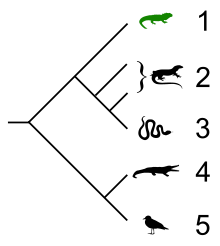
- Tuatara
- Lizards
- Snakes
- Crocodiles
- Birds
Tuatara, along with other now-extinct members of the order Sphenodontia, belong to the superorder Lepidosauria, the only surviving taxon within Lepidosauromorpha. Squamates and tuatara both show caudal autotomy (loss of the tail-tip when threatened), and have transverse cloacal slits.[33] The origin of the tuatara probably lies close to the split between the Lepidosauromorpha and the Archosauromorpha. Though tuatara resemble lizards, the similarity is superficial, because the family has several characteristics unique among reptiles. The typical lizard shape is very common for the early amniotes; the oldest known fossil of a reptile, the Hylonomus, resembles a modern lizard.[60]
Tuatara were originally classified as lizards in 1831 when the British Museum received a skull.[61] The genus remained misclassified until 1867, when A.C.L.G. Günther of the British Museum noted features similar to birds, turtles, and crocodiles. He proposed the order Rhynchocephalia (meaning "beak head") for the tuatara and its fossil relatives.[9]
At one point many disparately related species were incorrectly referred to the Rhynchocephalia, resulting in what taxonomists call a "wastebasket taxon".[62] Williston proposed the Sphenodontia to include only tuatara and their closest fossil relatives in 1925.[62] However, Rhynchocephalia is the older name[9] and in widespread use today. Sphenodon is derived from the Greek for "wedge" (σφήν, σφηνός/sphenos) and "tooth" (ὀδούς, ὀδόντος/odontos).[63]

Tuatara have been referred to as living fossils,[7] due to a perception that they retain many basal characteristics from around the time of the squamate–rhynchocephalian split (240 MYA).[10][64] Morphometric analyses of variation in jaw morphology among tuatara and extinct rhynchocephalian relatives have been argued to demonstrate morphological conservatism and support for the classification of tuatara as a 'living fossil',[22] but the reliability of these results has been criticised and debated.[23][24] Paleontological research on rhynchocephalians indicates that the group has undergone a variety of changes throughout the Mesozoic,[65][17][18][20] and the rate of molecular evolution for tuatara has been estimated to be among the fastest of any animal yet examined.[66][67] However, a 2020 analysis of the tuatara genome reached the opposite conclusion: That its rate of DNA substitutions per site is actually lower than for any analysed squamate.[11] Many of the niches occupied by lizards today were formerly held by rhynchocephalians. There was even a successful group of aquatic rhynchocephalians known as pleurosaurs, which differed markedly from living tuatara. Tuatara show cold-weather adaptations that allow them to thrive on the islands of New Zealand; these adaptations may be unique to tuatara since their sphenodontian ancestors lived in the much warmer climates of the Mesozoic. For instance, Palaeopleurosaurus appears to have had a much shorter lifespan compared to the modern tuatara.[68] Ultimately most scientists consider the phrase 'living fossil' to be unhelpful and misleading.[16][21]
A species of sphenodontine is known from the Miocene Saint Bathans Fauna. Whether it is referable to Sphenodon proper is not entirely clear, but is likely to be closely related to tuatara.[19]
Species
While there is currently considered to be only one living species of tuatara, two species were previously identified: Sphenodon punctatus, or northern tuatara, and the much rarer Sphenodon guntheri, or Brothers Island tuatara, which is confined to North Brother Island in Cook Strait.[69] The specific name punctatus is Latin for "spotted",[70] and guntheri refers to German-born British herpetologist Albert Günther.[71] A 2009 paper re-examined the genetic bases used to distinguish the two supposed species of tuatara, and concluded they only represent geographic variants, and only one species should be recognized.[29] Consequently, the northern tuatara was re-classified as Sphenodon punctatus punctatus and the Brothers Island tuatara as Sphenodon punctatus guntheri. Individuals from Brothers Island could also not be distinguished from other modern and fossil samples based on jaw morphology.[23]
The Brothers Island tuatara has olive brown skin with yellowish patches, while the colour of the northern tuatara ranges from olive green through grey to dark pink or brick red, often mottled, and always with white spots.[30][33][37] In addition, the Brothers Island tuatara is considerably smaller.[35] An extinct species of Sphenodon was identified in November 1885 by William Colenso, who was sent an incomplete subfossil specimen from a local coal mine. Colenso named the new species S. diversum.[72]
Genomic characteristics
Long interspersed nuclear elements (LINEs)
The most abundant LINE element in the tuátara is L2 (10%). Most of them are interspersed and can remain active. The longest L2 element found is 4 kb long and 83% of the sequences had ORF2p completely intact. The CR1 element is the second most repeated (4%). Phylogenetic analysis shows that these sequences are very different from those found in other nearby species such as lizards. Finally, less than 1% are elements belonging to L1, a low percentage since these elements tend to predominate in placental mammals.[11]
Usually, the predominant LINE elements are the CR1, contrary to what has been seen in the Tuátaras. This suggests that perhaps the genome repeats of sauropods were very different compared to mammals, birds and lizards.[11]
Major histocompatibility complex elements (MHCs)
The genes of the major histocompatibility complex (MHC) are known to play roles in disease resistance, mate choice, and kin recognition in various vertebrate species. Among known vertebrate genomes, MHCs are considered one of the most polymorphic.[73][74] In the tuatara, 56 MHC genes have been identified; some of which are similar to MHCs of amphibians and mammals. Most MHCs that were annotated in the tuatara genome are highly conserved, however there is large genomic rearrangement observed in distant lepidosauria lineages.[11]
Short interspersed nuclear elements (SINEs)
Many of the elements that have been analyzed are present in all amniotes, most are mammalian interspersed repeats or MIR, specifically the diversity of MIR subfamilies is the highest that has been studied so far in an amniote. 16 families of SINEs that were recently active have also been identified.[11]
DNA transposon
The Tuátara has 24 unique families of DNA transposons, and at least 30 subfamilies were recently active. This diversity is greater than what has been found in other amniotes and in addition, thousands of identical copies of these transposons have been analyzed, suggesting to researchers that there is recent activity.[11]
LTR retrotransposons
Around 7,500 LTRs have been identified, including 450 endogenous retroviruses (ERVs). Studies in other Sauropsida have recognized a similar number but nevertheless, in the genome of the tuatara it has been found a very old clade of retrovirus known as Spumavirus.[11]
Non-coding RNA
More than 8,000 non-coding RNA-related elements have been identified in tuatara genome, of which the vast majority, about 6,900, are derived from recently active transposable elements. The rest are related to ribosomal, spliceosomal and signal recognition particle RNA.[11]
Mitochondrial genome
The mitochondrial genome of the genus Sphenodon is approximately 18,000 bp in size and consists of 13 protein-coding genes, 2 ribosomal RNA and 22 transfer RNA genes.[11]
DNA methylation
DNA methylation is a very common modification in animals and the distribution of CpG sites within genomes affects this methylation. Specifically, 81% of these CpG sites have been found to be methylated in the tuatara genome. Recent publications propose that this high level of methylation may be due to the amount of repeating elements that exist in the genome of this animal. This pattern is closer to what occurs in organisms such as zebrafish, about 78%, while in humans it is only 70%.[11]
Behaviour

Adult tuatara are terrestrial and nocturnal reptiles, though they will often bask in the sun to warm their bodies. Hatchlings hide under logs and stones, and are diurnal, likely because adults are cannibalistic. Juveniles are typically active at night, but can be found active during the day. The juveniles' movement pattern is attributed to genetic hardwire of conspecifics for predator avoidance and thermal restrictions.[75] Tuatara thrive in temperatures much lower than those tolerated by most reptiles, and hibernate during winter.[76] They remain active at temperatures as low as 5 °C (41 °F),[77] while temperatures over 28 °C (82 °F) are generally fatal. The optimal body temperature for the tuatara is from 16 to 21 °C (61 to 70 °F), the lowest of any reptile.[78] The body temperature of tuatara is lower than that of other reptiles, ranging from 5.2–11.2 °C (41.4–52.2 °F) over a day, whereas most reptiles have body temperatures around 20 °C (68 °F).[79] The low body temperature results in a slower metabolism.
Burrowing seabirds such as petrels, prions, and shearwaters share the tuatara's island habitat during the birds' nesting seasons. The tuatara use the birds' burrows for shelter when available, or dig their own. The seabirds' guano helps to maintain invertebrate populations on which tuatara predominantly prey; including beetles, crickets, and spiders. Their diets also consist of frogs, lizards, and bird's eggs and chicks.[23] The diet of the tuatara varies seasonally and they mainly only consume fairy prions and their eggs in the summer.[80] In total darkness no feeding attempt whatsoever was observed[81] and the lowest light intensity at which an attempt to snatch a beetle was observed occurred under 0.0125 lux.[82] The eggs and young of seabirds that are seasonally available as food for tuatara may provide beneficial fatty acids.[33] Tuatara of both sexes defend territories, and will threaten and eventually bite intruders. The bite can cause serious injury.[83] Tuatara will bite when approached, and will not let go easily.[84]